Physics World news
Latest Articles
Quiz of the week: what device have physicists used to print ‘structural colours’?
Fancy some more? Check out our puzzles page.
The post Quiz of the week: what device have physicists used to print ‘structural colours’? appeared first on Physics World.
0
2
Officials hail ‘major milestone’ for US Deep Underground Neutrino Experiment
A vast complex of steel beams for a next-generation neutrino detector has begun its descent underground in what officials have called a “pivotal phase” towards construction of the $3.3bn Deep Underground Neutrino Experiment-Long-Baseline Neutrino Facility (DUNE-LBNF).
An event was held yesterday – attended by senior officials including CERN director-general Mark Thomson and Dario Gil, undersecretary for science at the US Department of Energy (DOE) – to commemorate the start of moving 4.5 million
0
2
New W boson mass measurement agrees with Standard Model predictions
Physicists have determined the mass of the W boson with the highest precision yet by analysing more than a billion proton collision events at CERN’s Large Hadron Collider (LHC). The new result confirms a prediction from the Standard Model of particle physics while refuting a comparably precise measurement made by Fermilab’s CDF Collaboration in 2022. This is significant because the older measurement, which used data from the defunct Tevatron collider, differed from the Standard Model’s predictio
0
2
Near-oxymoronic requirements: the materials challenges of fusion energy
Nuclear fusion powers the Sun, and scientists and engineers have long been trying to harness the process to generate clean energy. While much progress has been made, the commercially-viable generation of fusion energy remains elusive.
One important challenge is developing a range of specialized materials that can contain an extremely hot, radiation-emitting plasma in close proximity to ultracold superconducting magnets.
Our guest this week is Jacob John of the UK Atomic Energy Authority, who st
0
2
Word flower puzzle no. 4
How did you get on?
16 words Warming up nicely
24 words Getting hot, hot, hot
30 words Top dog!
Fancy some more? Check out our puzzles page.
The post Word flower puzzle no. 4 appeared first on Physics World.
0
1
One giant leap: Artemis II returns humanity to the Moon
After 54 years, numerous failed starts and countless abandoned dreams, earlier this year humanity finally returned to the Moon in an epic 10-day flight that gripped the planet. The Artemis II mission and its four astronauts – mission commander Reid Wiseman, pilot Victor Glover and mission specialists Christina Koch and Jeremy Hansen – gave us something to smile about during a dark time of global geopolitical turmoil.
The primary objective of the mission was to fly a crew around the Moon, to demo
0
1
Gap in neutrino energy spectrum raises questions about cosmic environments
A new analysis of data from the IceCube Neutrino Observatory suggests that the energy spectrum of cosmic neutrinos is more complex than was previously thought. Whereas a previous study found that the energies of these ubiquitous, nearly massless particles follow a simple power law distribution, the latest analysis reveals a knee-like bend in the spectrum at around 30 TeV. The discovery could help astrophysicists better understand where cosmic neutrinos come from and what objects and processes in
0
1
Theranostics: building the bridge between nuclear medicine and radiation oncology
In the ongoing quest to improve cancer treatments, the radiation oncology community is looking to add to its armoury of radiation-based treatments. In particular, radiopharmaceutical therapy (RPT) – also known as molecular radiotherapy (MRT) – and the emerging sub-field of theranostics are set to play an expanded role as radiation medicine shifts towards a more integrated, multidisciplinary approach.
RPT is an evolving modality that uses a tumour-targeting molecule attached to a therapeutic radi
0
1
Semiconductor metrology and standards will ensure the UK plays to its strengths
Smaller, faster, more efficient: the quest for relentless miniaturization has served the global semiconductor industry well – and, in fact, continues to do so, with the number of transistors on a microchip still doubling (per Moore’s Law) roughly every two years. Increasingly, however, applied scientists and engineers are redefining semiconductor progress along multiple axes of innovation.
The drivers? On the one hand, there is a convergence of new materials, advanced device concepts and heterog
0
1
Memory device breaks high-temperature performance record
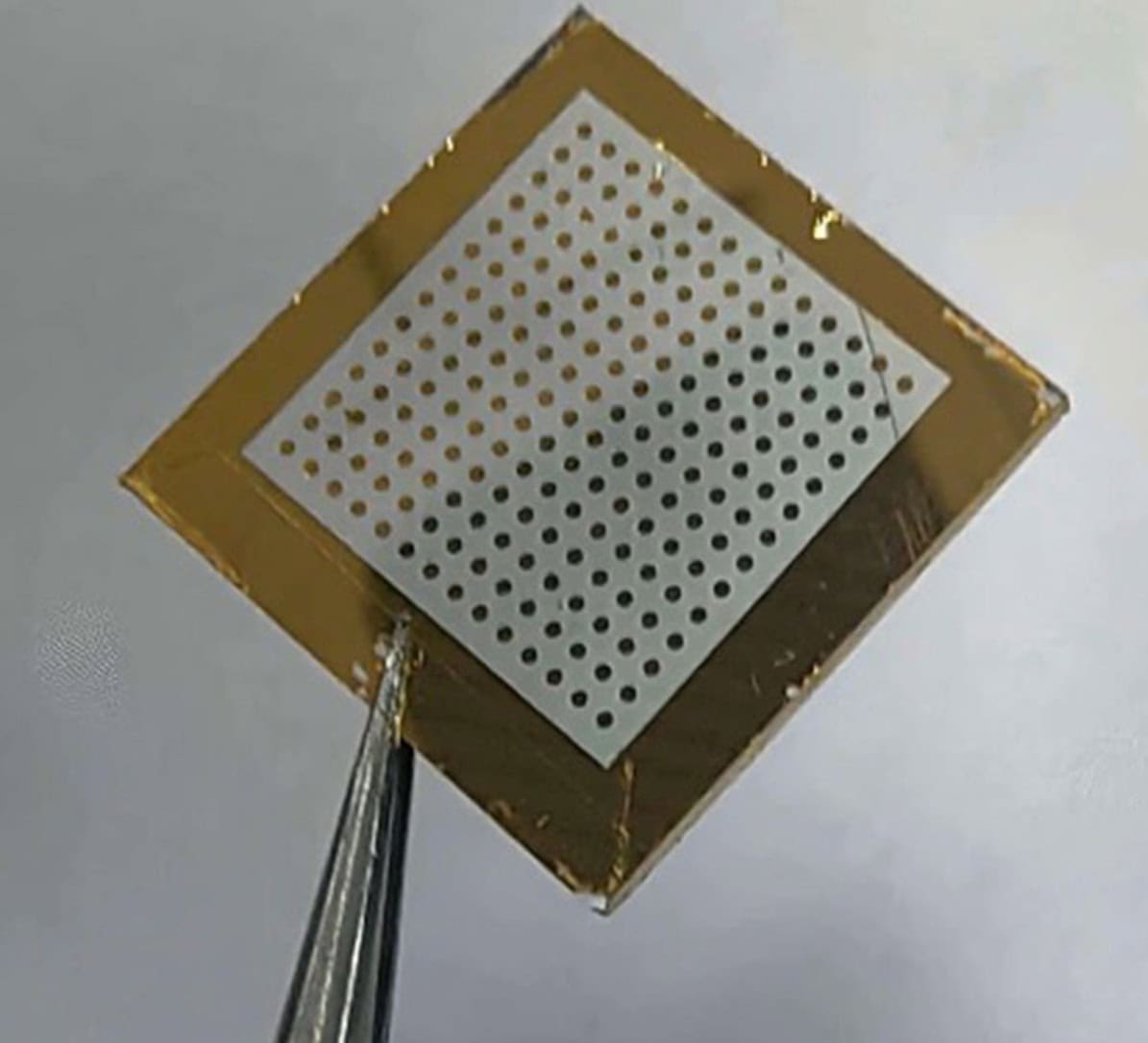
"An image of the memristor crossbar and possible application environments. (Courtesy: Jian Zhao)"An image of the memristor crossbar and possible application environments. (Courtesy: Jian Zhao)
A memory device that can operate at temperatures over 700 °C could enable electronic systems to withstand harsh conditions with less need for cooling. The device, which is a memristor based on graphene, tungsten and a hafnium oxide ceramic, can store data for over 50 hours, has a working voltage of just 1.
0
1
How polarons travel through TiO₂
Complex oxide materials form a large family of compounds with highly tuneable electronic properties, making them important for electronics, magnetic devices, and energy technologies. In many of these materials, electrons interact strongly with lattice vibrations and form polarons, quasiparticles consisting of an electron plus the surrounding lattice distortion. Polarons play a key role in determining how materials conduct electricity, but they are difficult to study because theoretical modelling
0
1
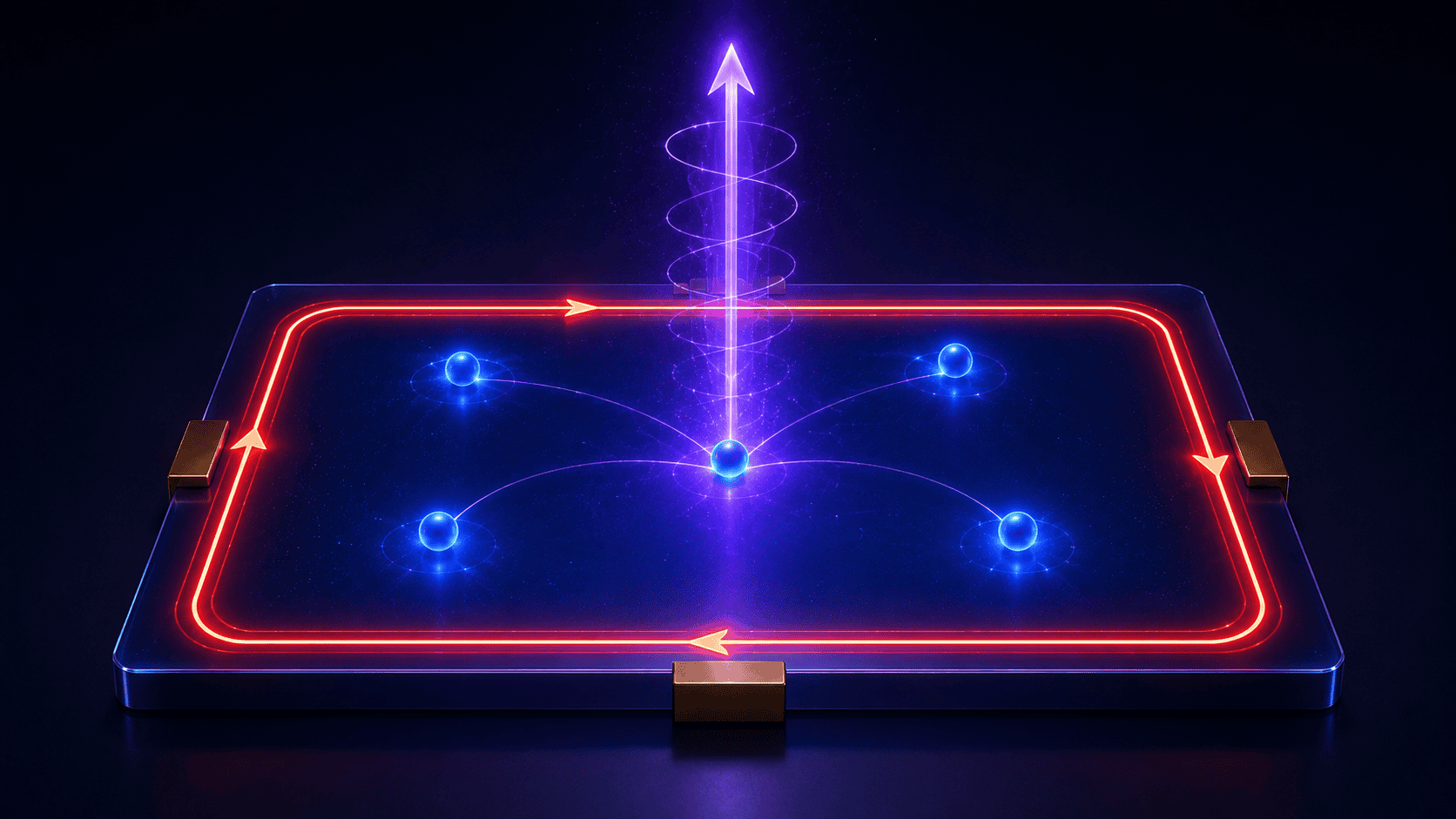
When Fermi arcs flip, the current flips
Weyl semimetals are quantum materials in which electrons behave as if they are massless, moving with a linear energy-momentum relationship similar to photons. These materials also host Weyl fermions with a built‑in chirality, meaning their spin and momentum are locked in either a left‑ or right‑handed configuration.
A distinctive feature of Weyl semimetals is the presence of Fermi arcs which are surface electronic states that connect projections of bulk Weyl nodes. Because these arcs inherit the
0
1
Decoupling electrical and thermal mechanisms could optimize brain tumour therapy
"<strong>Separating cell-death mechanisms<\/strong> Top row: brightfield images showing glioblastoma cell morphology under control (CT), pure electric field (E), pure thermal field (H) and TTFields (TTF) conditions. Red arrows indicate notable morphological changes; scale bar, 50 µm. Bottom row: cells stained for viability assessment under the same conditions; scale bar, 500 µm. (Courtesy: <em>Phys. Med. Biol.<\/em> 10.1088\/1361-6560\/ae5d81)"Separating cell-
0
1
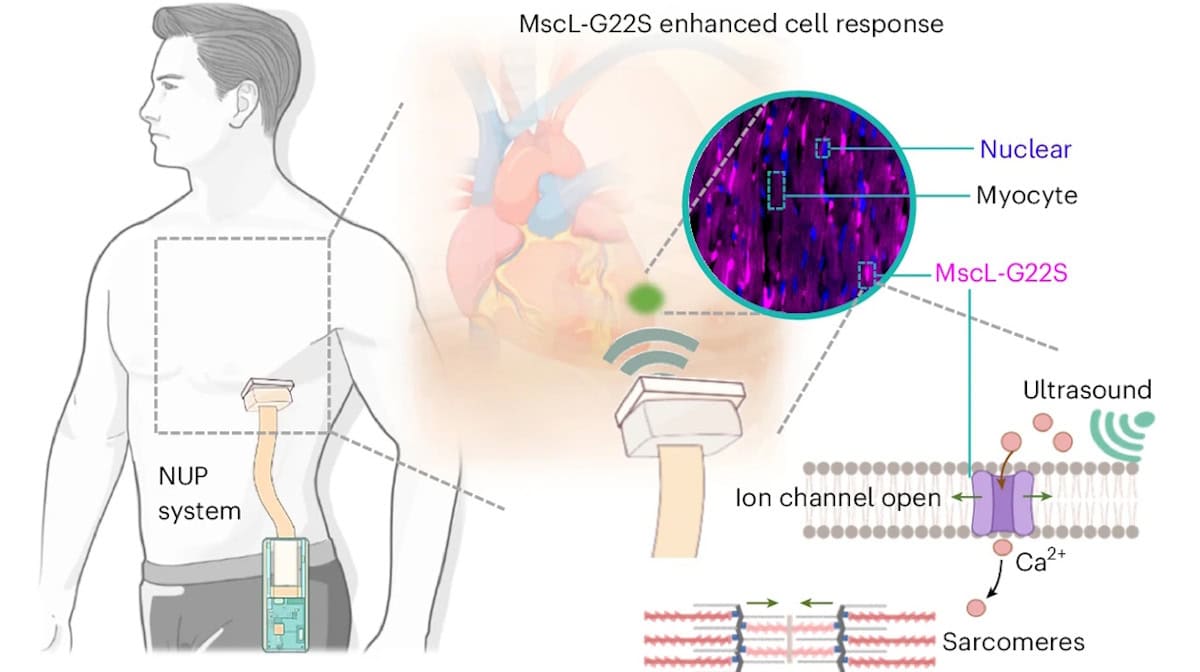
Proton therapy could improve treatment options for dangerous heart rhythm disorder
A first-in-human study from researchers at the Mayo Clinic has shown how proton therapy could provide a new treatment option for patients with hard-to-treat ventricular tachycardia (VT), a life-threatening heart rhythm disorder. In the small group of patients examined in this early feasibility study, the treatment led to a 79% reduction in VT episodes.
VT is a type of abnormal heartbeat in which faulty electrical signals in the ventricles cause the heart to beat too quickly, meaning that it can’
0
1
The strange metaphor of Euglena’s tail
Quantum mechanics is so full of strange phenomena that it’s not surprising that physicists have had to dream up some vivid metaphors to explain them. Who can’t help but think of cats in boxes when contemplating superposition or balls of jumbled yarn when musing over entanglement? Like all metaphors, these use familiar experiences to help understand the unfamiliar.
Metaphors come in many different types. “Love is a rose”, for instance, is a “filtrative” metaphor, in which a secondary subject (a r
0
1
Quiz of the week: how far can new tiny knotted fibre leap into the air?
Fancy some more? Check out our puzzles page.
The post Quiz of the week: how far can new tiny knotted fibre leap into the air? appeared first on Physics World.
0
3
Tiny knotted fibre leaps into the air like a springtail bug
Researchers at the University of Pennsylvania and the University of California, Los Angeles, have created a tiny, soft knot-like fibre that can jump metres into the air.
The fibre is less than a millimetre thick, and a few millimetres long and contains a Kevlar core surrounded by a shell of liquid crystal elastomer (LCE).
The Kevlar provides strength and stiffness while the LCE adds some flexibility and responsiveness.
“People think of a knotted fibre as something passive,” says Shu Yang from t
0
2
Caffeine kick: can you solve our crossword on coffee physics?
See how much you know about the subject by trying our interactive crossword. Most of the clues are based on the article, but there are a few additional brain teasers thrown in. If you’re feeling stuck, check out the “assist” menu for help.
The post Caffeine kick: can you solve our crossword on coffee physics? appeared first on Physics World.
0
2
Researchers print structural colour with an inkjet printer
"<strong>Non-fading and non-toxic<\/strong> Images printed with structural colour ink can be made both highly transparent to transmitted light (top) and at the same time reflect light from above in vivid colours (bottom) – two properties that are typically considered mutually exclusive. (Courtesy: H Yamana <em>et al. Advanced Materials<\/em> 10.1002\/adma.202523036 2026)"Non-fading and non-toxic Images printed with structural colour ink can be made both highly trans
0
4
In food physics, connection and collaboration are ingredients for a thriving IOP community
Food physicists have a lot on their plate just now. Across academia and industry, the community faces systemic challenges, not least the obesity epidemic, mounting health-and-safety concerns around ultra-processed foods, and the regulatory backlash against plastic food-packaging waste.
The war in the Middle East is another uncomfortable wake-up call. While the effective closure of the Strait of Hormuz to commercial shipping has sent oil and gas prices soaring, that strategic choke point has also
0
3
Quiz of the week: what device have physicists used to print ‘structural colours’?
Fancy some more? Check out our puzzles page.
The post Quiz of the week: what device have physicists used to print ‘
0
2
Officials hail ‘major milestone’ for US Deep Underground Neutrino Experiment
A vast complex of steel beams for a next-generation neutrino detector has begun its descent underground in what official
0
2
New W boson mass measurement agrees with Standard Model predictions
Physicists have determined the mass of the W boson with the highest precision yet by analysing more than a billion proto
0
2
Near-oxymoronic requirements: the materials challenges of fusion energy
Nuclear fusion powers the Sun, and scientists and engineers have long been trying to harness the process to generate cle
0
2
Word flower puzzle no. 4
How did you get on?
16 words Warming up nicely
24 words Getting hot, hot, hot
30 words Top dog!
Fancy some more? Check o
0
1
One giant leap: Artemis II returns humanity to the Moon
After 54 years, numerous failed starts and countless abandoned dreams, earlier this year humanity finally returned to th
0
1
Gap in neutrino energy spectrum raises questions about cosmic environments
A new analysis of data from the IceCube Neutrino Observatory suggests that the energy spectrum of cosmic neutrinos is mo
0
1
Theranostics: building the bridge between nuclear medicine and radiation oncology
In the ongoing quest to improve cancer treatments, the radiation oncology community is looking to add to its armoury of
0
1
Semiconductor metrology and standards will ensure the UK plays to its strengths
Smaller, faster, more efficient: the quest for relentless miniaturization has served the global semiconductor industry w
0
1
Memory device breaks high-temperature performance record
"An image of the memristor crossbar and possible application environments. (Courtesy: Jian Zhao)"An image of the memrist
0
1
How polarons travel through TiO₂
Complex oxide materials form a large family of compounds with highly tuneable electronic properties, making them importa
0
1
When Fermi arcs flip, the current flips
Weyl semimetals are quantum materials in which electrons behave as if they are massless, moving with a linear energy-mom
0
1
Decoupling electrical and thermal mechanisms could optimize brain tumour therapy
"<strong>Separating cell-death mechanisms<\/strong> Top row: brightfield images showing glioblastoma cell mo
0
1
Proton therapy could improve treatment options for dangerous heart rhythm disorder
A first-in-human study from researchers at the Mayo Clinic has shown how proton therapy could provide a new treatment op
0
1
The strange metaphor of Euglena’s tail
Quantum mechanics is so full of strange phenomena that it’s not surprising that physicists have had to dream up some viv
0
1
Quiz of the week: how far can new tiny knotted fibre leap into the air?
Fancy some more? Check out our puzzles page.
The post Quiz of the week: how far can new tiny knotted fibre leap into the
0
3
Tiny knotted fibre leaps into the air like a springtail bug
Researchers at the University of Pennsylvania and the University of California, Los Angeles, have created a tiny, soft k
0
2
Caffeine kick: can you solve our crossword on coffee physics?
See how much you know about the subject by trying our interactive crossword. Most of the clues are based on the article,
0
2
Quiz of the week: what device have physicists used to print ‘structural colours’?
Fancy some more? Check out our puzzles page.
The post Quiz of the week: what device have physicists used to print ‘structural colours’? appeared first on Physics World.
0
2 👁
Officials hail ‘major milestone’ for US Deep Underground Neutrino Experiment
A vast complex of steel beams for a next-generation neutrino detector has begun its descent underground in what officials have called a “pivotal phase” towards construction of the $3.3bn Deep Underground Neutrino Experiment-Long-Baseline Neutrino Facility (DUNE-LBNF).
An event was held yesterday – attended by senior officials including CERN director-general Mark Thomson and Dario Gil, undersecretary for science at the US Department of Energy (DOE) – to commemorate the start of moving 4.5 million
0
2 👁
New W boson mass measurement agrees with Standard Model predictions
Physicists have determined the mass of the W boson with the highest precision yet by analysing more than a billion proton collision events at CERN’s Large Hadron Collider (LHC). The new result confirms a prediction from the Standard Model of particle physics while refuting a comparably precise measurement made by Fermilab’s CDF Collaboration in 2022. This is significant because the older measurement, which used data from the defunct Tevatron collider, differed from the Standard Model’s predictio
0
2 👁
Near-oxymoronic requirements: the materials challenges of fusion energy
Nuclear fusion powers the Sun, and scientists and engineers have long been trying to harness the process to generate clean energy. While much progress has been made, the commercially-viable generation of fusion energy remains elusive.
One important challenge is developing a range of specialized materials that can contain an extremely hot, radiation-emitting plasma in close proximity to ultracold superconducting magnets.
Our guest this week is Jacob John of the UK Atomic Energy Authority, who st
0
2 👁
Word flower puzzle no. 4
How did you get on?
16 words Warming up nicely
24 words Getting hot, hot, hot
30 words Top dog!
Fancy some more? Check out our puzzles page.
The post Word flower puzzle no. 4 appeared first on Physics World.
0
1 👁
One giant leap: Artemis II returns humanity to the Moon
After 54 years, numerous failed starts and countless abandoned dreams, earlier this year humanity finally returned to the Moon in an epic 10-day flight that gripped the planet. The Artemis II mission and its four astronauts – mission commander Reid Wiseman, pilot Victor Glover and mission specialists Christina Koch and Jeremy Hansen – gave us something to smile about during a dark time of global geopolitical turmoil.
The primary objective of the mission was to fly a crew around the Moon, to demo
0
1 👁
Gap in neutrino energy spectrum raises questions about cosmic environments
A new analysis of data from the IceCube Neutrino Observatory suggests that the energy spectrum of cosmic neutrinos is more complex than was previously thought. Whereas a previous study found that the energies of these ubiquitous, nearly massless particles follow a simple power law distribution, the latest analysis reveals a knee-like bend in the spectrum at around 30 TeV. The discovery could help astrophysicists better understand where cosmic neutrinos come from and what objects and processes in
0
1 👁
Theranostics: building the bridge between nuclear medicine and radiation oncology
In the ongoing quest to improve cancer treatments, the radiation oncology community is looking to add to its armoury of radiation-based treatments. In particular, radiopharmaceutical therapy (RPT) – also known as molecular radiotherapy (MRT) – and the emerging sub-field of theranostics are set to play an expanded role as radiation medicine shifts towards a more integrated, multidisciplinary approach.
RPT is an evolving modality that uses a tumour-targeting molecule attached to a therapeutic radi
0
1 👁
Semiconductor metrology and standards will ensure the UK plays to its strengths
Smaller, faster, more efficient: the quest for relentless miniaturization has served the global semiconductor industry well – and, in fact, continues to do so, with the number of transistors on a microchip still doubling (per Moore’s Law) roughly every two years. Increasingly, however, applied scientists and engineers are redefining semiconductor progress along multiple axes of innovation.
The drivers? On the one hand, there is a convergence of new materials, advanced device concepts and heterog
0
1 👁
Memory device breaks high-temperature performance record
"An image of the memristor crossbar and possible application environments. (Courtesy: Jian Zhao)"An image of the memristor crossbar and possible application environments. (Courtesy: Jian Zhao)
A memory device that can operate at temperatures over 700 °C could enable electronic systems to withstand harsh conditions with less need for cooling. The device, which is a memristor based on graphene, tungsten and a hafnium oxide ceramic, can store data for over 50 hours, has a working voltage of just 1.
0
1 👁
How polarons travel through TiO₂
Complex oxide materials form a large family of compounds with highly tuneable electronic properties, making them important for electronics, magnetic devices, and energy technologies. In many of these materials, electrons interact strongly with lattice vibrations and form polarons, quasiparticles consisting of an electron plus the surrounding lattice distortion. Polarons play a key role in determining how materials conduct electricity, but they are difficult to study because theoretical modelling
0
1 👁
When Fermi arcs flip, the current flips
Weyl semimetals are quantum materials in which electrons behave as if they are massless, moving with a linear energy-momentum relationship similar to photons. These materials also host Weyl fermions with a built‑in chirality, meaning their spin and momentum are locked in either a left‑ or right‑handed configuration.
A distinctive feature of Weyl semimetals is the presence of Fermi arcs which are surface electronic states that connect projections of bulk Weyl nodes. Because these arcs inherit the
0
1 👁
Decoupling electrical and thermal mechanisms could optimize brain tumour therapy
"<strong>Separating cell-death mechanisms<\/strong> Top row: brightfield images showing glioblastoma cell morphology under control (CT), pure electric field (E), pure thermal field (H) and TTFields (TTF) conditions. Red arrows indicate notable morphological changes; scale bar, 50 µm. Bottom row: cells stained for viability assessment under the same conditions; scale bar, 500 µm. (Courtesy: <em>Phys. Med. Biol.<\/em> 10.1088\/1361-6560\/ae5d81)"Separating cell-
0
1 👁
Proton therapy could improve treatment options for dangerous heart rhythm disorder
A first-in-human study from researchers at the Mayo Clinic has shown how proton therapy could provide a new treatment option for patients with hard-to-treat ventricular tachycardia (VT), a life-threatening heart rhythm disorder. In the small group of patients examined in this early feasibility study, the treatment led to a 79% reduction in VT episodes.
VT is a type of abnormal heartbeat in which faulty electrical signals in the ventricles cause the heart to beat too quickly, meaning that it can’
0
1 👁
The strange metaphor of Euglena’s tail
Quantum mechanics is so full of strange phenomena that it’s not surprising that physicists have had to dream up some vivid metaphors to explain them. Who can’t help but think of cats in boxes when contemplating superposition or balls of jumbled yarn when musing over entanglement? Like all metaphors, these use familiar experiences to help understand the unfamiliar.
Metaphors come in many different types. “Love is a rose”, for instance, is a “filtrative” metaphor, in which a secondary subject (a r
0
1 👁
Quiz of the week: how far can new tiny knotted fibre leap into the air?
Fancy some more? Check out our puzzles page.
The post Quiz of the week: how far can new tiny knotted fibre leap into the air? appeared first on Physics World.
0
3 👁
Tiny knotted fibre leaps into the air like a springtail bug
Researchers at the University of Pennsylvania and the University of California, Los Angeles, have created a tiny, soft knot-like fibre that can jump metres into the air.
The fibre is less than a millimetre thick, and a few millimetres long and contains a Kevlar core surrounded by a shell of liquid crystal elastomer (LCE).
The Kevlar provides strength and stiffness while the LCE adds some flexibility and responsiveness.
“People think of a knotted fibre as something passive,” says Shu Yang from t
0
2 👁
Caffeine kick: can you solve our crossword on coffee physics?
See how much you know about the subject by trying our interactive crossword. Most of the clues are based on the article, but there are a few additional brain teasers thrown in. If you’re feeling stuck, check out the “assist” menu for help.
The post Caffeine kick: can you solve our crossword on coffee physics? appeared first on Physics World.
0
2 👁
Researchers print structural colour with an inkjet printer
"<strong>Non-fading and non-toxic<\/strong> Images printed with structural colour ink can be made both highly transparent to transmitted light (top) and at the same time reflect light from above in vivid colours (bottom) – two properties that are typically considered mutually exclusive. (Courtesy: H Yamana <em>et al. Advanced Materials<\/em> 10.1002\/adma.202523036 2026)"Non-fading and non-toxic Images printed with structural colour ink can be made both highly trans
0
4 👁
In food physics, connection and collaboration are ingredients for a thriving IOP community
Food physicists have a lot on their plate just now. Across academia and industry, the community faces systemic challenges, not least the obesity epidemic, mounting health-and-safety concerns around ultra-processed foods, and the regulatory backlash against plastic food-packaging waste.
The war in the Middle East is another uncomfortable wake-up call. While the effective closure of the Strait of Hormuz to commercial shipping has sent oil and gas prices soaring, that strategic choke point has also
0
3 👁
Quiz of the week: what device have physicists used to print ‘structural colours’?
Fancy some more? Check out our puzzles page.
The post Quiz of the week: what device have physicists used to print ‘structura…
💬 0
👁 2
Officials hail ‘major milestone’ for US Deep Underground Neutrino Experiment
Physics World · 6d ago
💬 0
👁 2
New W boson mass measurement agrees with Standard Model predictions
Physics World · May 8, 2026
💬 0
👁 2
Near-oxymoronic requirements: the materials challenges of fusion energy
Physics World · May 7, 2026
💬 0
👁 2

Word flower puzzle no. 4
Physics World · May 7, 2026

One giant leap: Artemis II returns humanity to the Moon
Physics World · May 7, 2026

Gap in neutrino energy spectrum raises questions about cosmic environments
Physics World · May 7, 2026

Theranostics: building the bridge between nuclear medicine and radiation oncology
Physics World · May 6, 2026
Semiconductor metrology and standards will ensure the UK plays to its strengths
Smaller, faster, more efficient: the quest for relentless miniaturization has served the global semiconductor industry well – and,…
💬 0
👁 1
Memory device breaks high-temperature performance record
Physics World · May 6, 2026
💬 0
👁 1
How polarons travel through TiO₂
Physics World · May 6, 2026
💬 0
👁 1
When Fermi arcs flip, the current flips
Physics World · May 6, 2026
💬 0
👁 1

Decoupling electrical and thermal mechanisms could optimize brain tumour therapy
Physics World · May 6, 2026

Proton therapy could improve treatment options for dangerous heart rhythm disorder
Physics World · May 5, 2026

The strange metaphor of Euglena’s tail
Physics World · May 4, 2026

Quiz of the week: how far can new tiny knotted fibre leap into the air?
Physics World · May 1, 2026
Tiny knotted fibre leaps into the air like a springtail bug
Researchers at the University of Pennsylvania and the University of California, Los Angeles, have created a tiny, soft knot-like f…
💬 0
👁 2
Caffeine kick: can you solve our crossword on coffee physics?
Physics World · May 1, 2026
💬 0
👁 2
Researchers print structural colour with an inkjet printer
Physics World · May 1, 2026
💬 0
👁 4
In food physics, connection and collaboration are ingredients for a thriving IOP community
Physics World · May 1, 2026
💬 0
👁 3